Many injection molding problems, such as sink marks, warpage and parts sticking in the mold, start on the drawing. Getting wall thickness, draft angles and radii right before tooling leads to a simpler mold and smoother production.
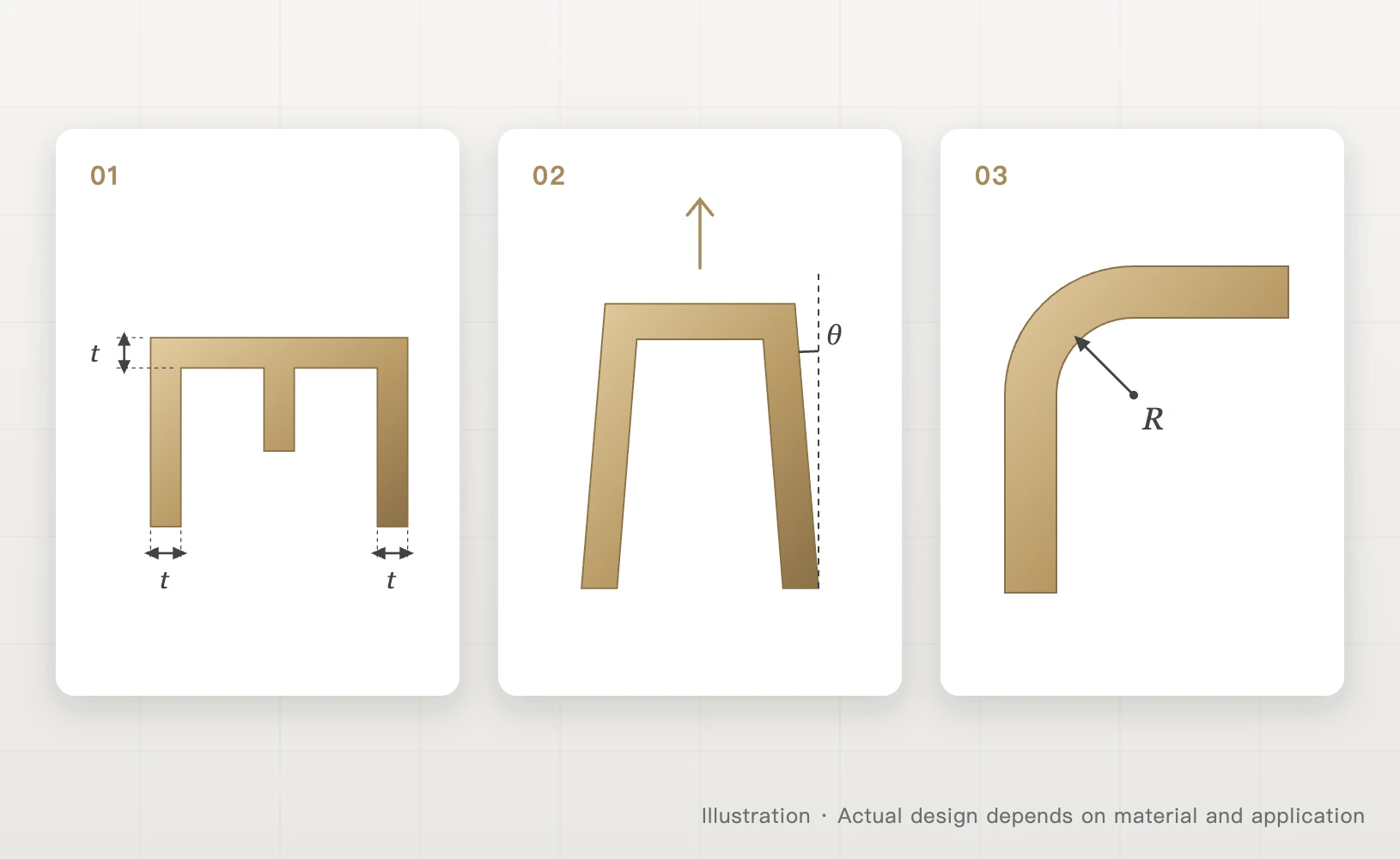
1. Wall thickness: keep it uniform
- Typical plastic parts have walls of about 1–4 mm, depending on the material and part size.
- Large thickness differences cool at different rates and often cause sink marks and warpage.
- Core out thick sections or use ribs for strength; this saves material and shortens cycle time.
- Where thickness must change, use a gradual transition instead of a sudden step.
Ribs are usually thinner than the main wall so sink marks do not appear on the opposite surface.
2. Draft angles: help the part release
- Surfaces parallel to the mold opening direction need a slight taper so the part can be ejected cleanly.
- About 0.5° to 2° is common; deeper features usually need more.
- Textured surfaces need extra draft to avoid scuffing.
- Without draft, parts may stick, show drag marks or even deform during ejection.
If draft is not acceptable on a cosmetic surface, discuss it with the molder early to find a workable solution.
3. Radii: avoid sharp corners
- Sharp corners concentrate stress and are where parts tend to crack.
- Rounded corners let the plastic flow more smoothly, reducing short shots and flow marks.
- A common rule: inside radius at least half the wall thickness, and outside radius = inside radius + wall thickness, which keeps the corner thickness uniform.
- Radii also make parts safer to handle and give a more refined look.
Other details to review before tooling
- Undercuts and side holes add slides or lifters; changing the design early can lower tooling cost.
- Screw bosses near walls should be connected with ribs instead of thick sections, to avoid sink.
- Material: shrinkage varies by resin, so wall thickness and tolerances should be considered together. See choosing between PP, PE and ABS.
Every part is different. The figures above are general guidelines; the final design depends on material, application and appearance requirements.
Still finalizing your design? Send us your drawings (STEP, IGES, DWG or PDF), and Chien Chen will review wall thickness, draft angles and radii before tooling, for a simpler mold and more stable production. Request a quote.