One of the first questions in a tooling quote is how many cavities the mold should have. The cavity count directly affects tooling cost, unit price, output and machine size. Here is how single-cavity, multi-cavity and family molds compare, and how to choose the right one.
1. What is a cavity?
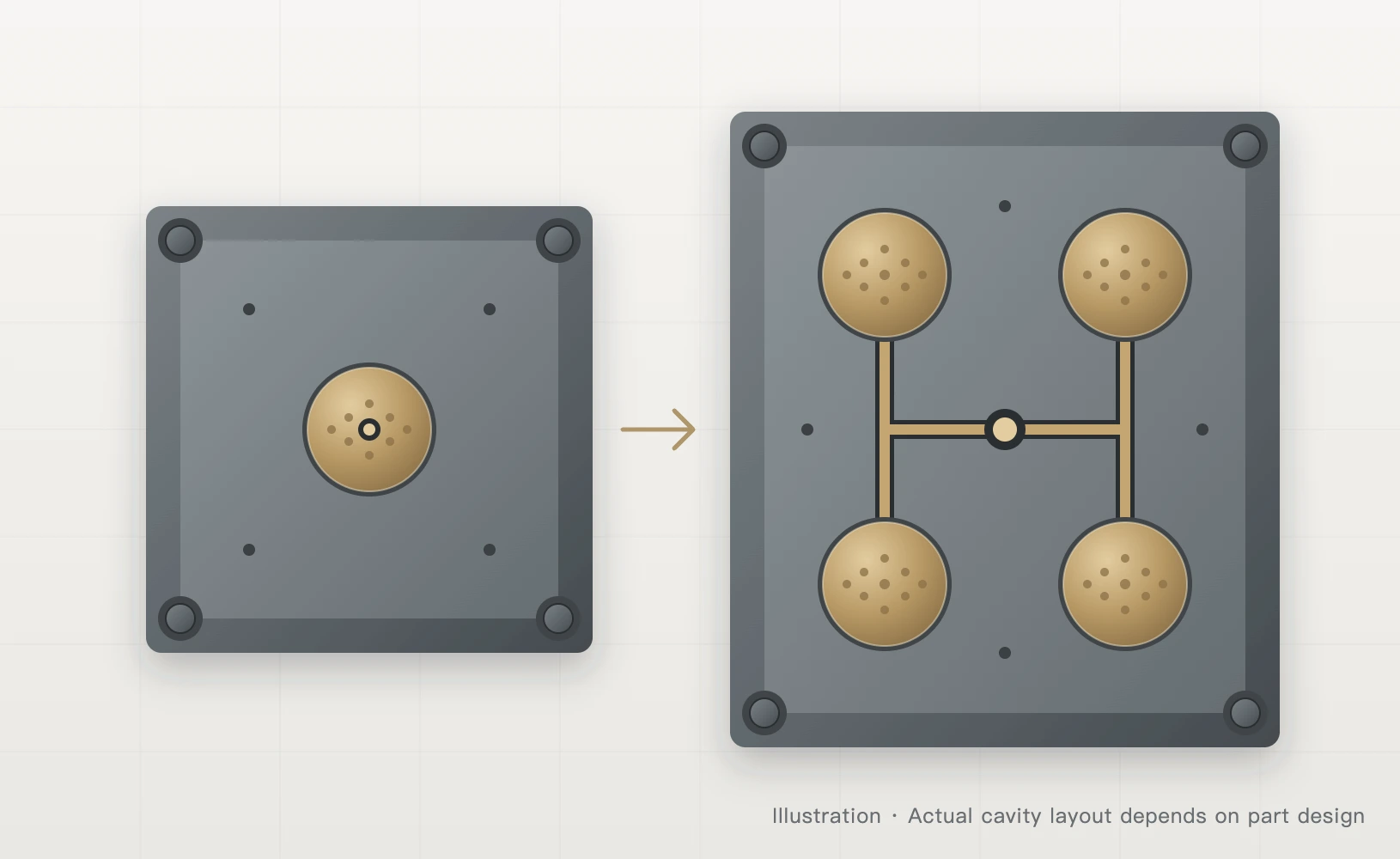
- A cavity is the part-shaped space inside the mold; plastic fills it and cools into the finished part.
- A single-cavity mold makes 1 part per shot; a 4-cavity mold makes 4.
- Cavity counts are usually symmetrical, such as 2, 4, 8 or 16, so the melt reaches every cavity evenly.
2. Single-cavity molds: simple and economical
- Lowest tooling cost, shorter lead time and simpler maintenance.
- Every shot runs under identical conditions, so dimensions are easiest to control.
- Best for: early development, lower volumes, large parts and tight-tolerance parts.
3. Multi-cavity molds: best for high volume
- Cycle time stays similar while several parts are made per shot, so output rises and unit price falls.
- The mold is larger and costs more, and the machine must match: multiply clamping force and shot size by the number of cavities.
- All cavities must fill at the same time (a balanced runner), or some cavities may show short shots or flash and dimensions will vary.
Small, high-volume parts with stable designs, such as caps and fittings, benefit most from multi-cavity tooling.
4. Family molds: different parts in one mold
- One mold produces different parts, such as a lid and a base, in the same shot.
- Suitable for parts needed in equal quantities for assembly, which simplifies production and shipping.
- Keep in mind: parts of very different sizes are hard to balance, and changing one part means modifying the whole mold.
How to choose
- Development stage or low volume: start with a single-cavity mold to prove the design.
- High annual volume and stable design: multi-cavity gives the lowest unit price.
- Large or precision parts: fewer cavities for more consistent quality.
- Small parts sold as a set: consider a family mold.
A common approach is to start with a single-cavity mold and add a multi-cavity mold once demand is stable. For other factors behind tooling price, see How Much Does an Injection Mold Cost?
Not sure how many cavities your mold needs? Send us your drawings, material and estimated annual volume, and Chien Chen will recommend a cavity count and machine size that balance tooling cost and unit price. Request a quote.