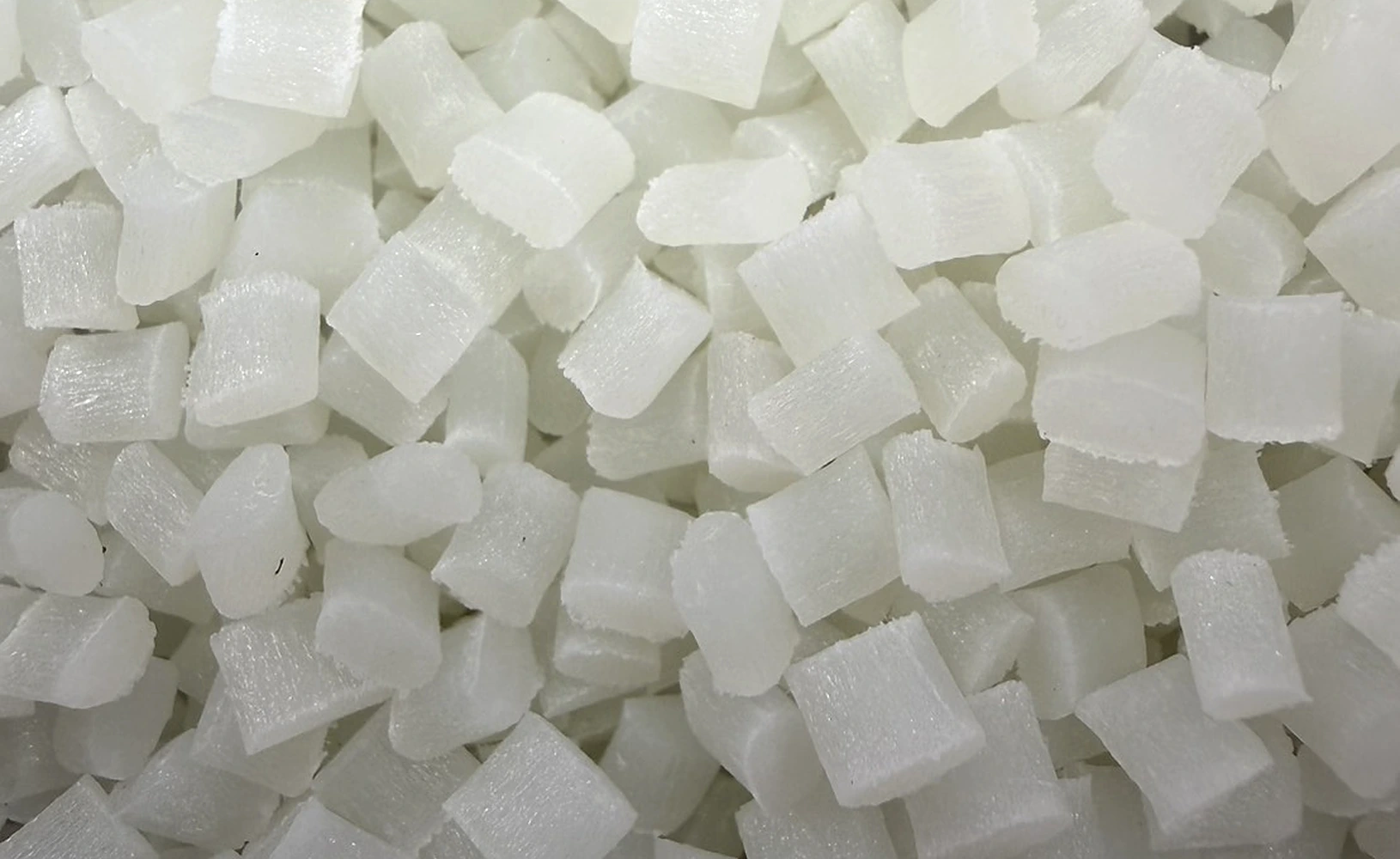
When a part has to withstand friction, impact or load, nylon (PA, polyamide) is often the first choice. Reinforced with glass fiber, it becomes PA+GF, the material behind many tool and machine components.
Properties of nylon (PA)
- Wear resistant with low friction; tough and hard to break.
- Resistant to oils and most solvents.
- Common grades are PA6 and PA66; PA66 offers higher heat resistance.
- Absorbs moisture from the air, which changes dimensions and properties, so allow for it in the design.
What glass fiber (PA+GF) changes
- Glass content typically ranges from 15% to 50%, e.g. PA6 + 30% GF.
- Much higher stiffness, strength and heat deflection temperature.
- Better dimensional stability and less affected by moisture.
- Fibers align with the melt flow, which can cause uneven shrinkage and warpage, and fibers may show on the surface; the mold design has to account for this.
Molding considerations
- Dry the resin thoroughly before molding to avoid splay, voids and loss of strength.
- Glass fiber is abrasive to screws and molds, so steel selection and gate design matter.
- Gate location controls fiber orientation, which affects strength and warpage.
Typical uses: hand tool housings, fan impellers, gears, fasteners and structural machine parts.
Chien Chen has been molding plastics in Taichung, Taiwan for nearly 40 years. We can help you choose the right material for your application, environment and budget. Send us your drawings or samples and request a quote.